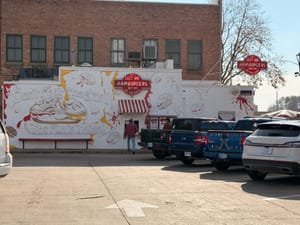
City officials to meet privately with legal counsel to discuss recent federal court ruling
The Salina City Commission will hold its second consecutive executive session to discuss the Cozy Inn mural lawsuit when it meets Monday, as city officials continue weighing their options following a federal court ruling that found the city violated the First Amendment.
According to the meeting agenda, commissioners will recess into executive session to "discuss with special legal counsel the subject of legal considerations relating to the Cozy Inn vs. City of Salina case." The session is being held under Kansas law allowing private attorney-client consultations.
According to City Manager Jacob Wood, "The City has not taken any action on the Cozy case. We are still exploring our options and will take action at a public meeting when the time is right."
The second, closed-door discussion comes nearly two weeks after U.S. District Court Judge Toby Crouse issued a 35-page ruling that delivered a mixed verdict in the nearly two-year legal battle. While the court sided with the city on one claim, it ruled against Salina on two critical First Amendment issues.
Second Meeting on the Case
This marks the second straight commission meeting where the Cozy Inn case will be discussed in executive session. Mayor Greg Lenkiewicz indicated last week that such a meeting would be needed to evaluate the court's ruling and potential next steps.
"That is a conversation we [commission and counsel] are going to have," Lenkiewicz said when asked about a possible appeal. "That's going to happen in an executive session."
The city previously released a statement acknowledging it is "working with its attorneys to evaluate the broader implications of the Court's Order and potential next steps towards resolution of the matter."
What the Court Ruled
Judge Crouse's November 19 ruling found that Salina's distinction between regulated "signs" and unregulated "murals" violated the First Amendment. The court concluded that the city engaged in unconstitutional content-based discrimination by treating displays differently based on whether they depicted products sold on the premises.
The ruling also found that Salina imposed an improper prior restraint on speech by placing restaurant owner Steve Howard's permit application on indefinite hold rather than approving or denying it.
However, the court sided with the city on Howard's claim that the sign code was unconstitutionally vague, finding that key terms like "advertise" were sufficiently clear.
Executive Session Explained
Under Kansas law, governing bodies may meet privately to discuss pending or anticipated litigation with their attorneys. Such discussions are protected by attorney-client privilege and are one of the few exceptions to the state's open meetings requirements.
The executive session will be closed to the public and media. However, any formal action the commission takes—such as deciding whether to appeal the ruling or settle the case—must be voted on in open session.
The agenda does not specify how long the executive session will last, though such meetings typically include a time limit that can be extended if needed.
High Stakes Decision
The commission faces a consequential decision with no clear easy path forward. An appeal to the U.S. Court of Appeals for the Tenth Circuit would mean additional legal expenses on top of the more than $650,000 the city has already spent defending its sign ordinance, with no guarantee of success.
Accepting the ruling, on the other hand, would mean acknowledging that the city cannot enforce its current mural-sign distinction and could potentially expose Salina to a lawsuit seeking recovery of the Cozy Inn's legal fees.
Kansas Justice Institute litigation director Samuel MacRoberts said last week that the organization would discuss fee recovery with Howard.
"That is a conversation we are going to have with Steve later on," MacRoberts said.
The Mural Project
The dispute centers on a UFO-themed mural that Howard began painting on The Cozy Inn's exterior wall in November 2023. City officials stopped the work after three days, determining that the artwork's flying UFOs too closely resembled hamburgers—making it an advertisement rather than art.
Judge Crouse's ruling means Howard can now complete the mural, which is planned to depict "whimsical hamburger-esque flying saucers piloted by aliens attacking The Cozy with blasts of ketchup and mustard," according to court documents.
The century-old restaurant has been a Salina institution since 1922.
Next Steps
If the city decides to appeal, it would have 30 days from the entry of final judgment to file a notice of appeal. The Tenth Circuit typically hears cases in Denver with a three-judge panel.
Any decision about an appeal or other resolution would need to be announced and voted on in public session.