
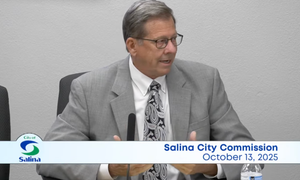
“I’m a big cheerleader for the city of Salina,” Commissioner Mike Hoppock said, explaining why he investigated recent complaints that “taxes in Salina are pushing people away.” “I better, better do my own homework, and I better do some research,” he said.
Hoppock walked through how property taxes are calculated, saying the Saline County Appraiser sets values each January, then assessed values are calculated using a multiplier (about 11.5 percent for residential property and 25 percent for commercial property) before the mill levy is applied. He noted the five major taxing entities that affect Salina property taxes: USD 305, Saline County, the City of Salina, the Airport Authority and the Library.
Key points Hoppock reported from his review:
- He said Saline County’s combined mill levy, for all taxing entities, is lower than 90 of the 105 Kansas counties — meaning only 15 counties have lower total mill levies than Saline County.
- Looking at sales vs. appraisals, Hoppock said 79 percent of residential sales in Salina in 2025 closed above the January 2025 appraised value, which he interpreted as evidence that appraisals are broadly in line with the market.
- Comparing Salina to peer cities (excluding the Kansas City area), Hoppock said only Hays had a lower mill levy than Salina. He cited Salina’s 2024 mill levy as 29.417, Hays at 24.997, and noted other peers range higher; he said Manhattan is in the low 50s and McPherson is roughly 53.8.
Hoppock said the city’s financial strength is the result of deliberate choices made by the commission and staff. He pointed to a roughly $28 million general reserve balance and described several specific actions he credits with strengthening the city’s finances:
- During the pandemic the city pursued cost-saving measures — including furloughs, job sharing and cutting seasonal hires — to preserve staff while reducing payroll outlays. “We were proactive and not reactive to what was going on at that time,” he said.
- An RFP for banking services in 2023, Hoppock said, helped increase investment income from about $300,000 per year to roughly $4 million per year.
- The city moved to leasing vehicles in some cases to free capital for priority needs.
- The commission used transient guest tax revenue to fund turf at Bill Burke Park and to build a reserve for future replacement, which Hoppock said keeps that maintenance off the general taxpayer burden.
- The city is planning a new fire station estimated at about $9 million; because of current reserves, Hoppock said the commission could choose to pay a large portion in cash in 2026, potentially saving an estimated $1–$2 million in interest versus full bond financing.
Responding to critics, Hoppock said, “When I hear people say, ‘We don’t care about the taxpayer,’ they haven’t been paying a lot of attention.” He stressed the city is not perfect, but said staff and past commissions have taken steps to keep Salina affordable while building financial resilience.
“I hope that some of the news outlets that like to talk about the bad will pick up on this and maybe can actually talk a little bit about the good going on in the city of Salina,” Hoppock said.