
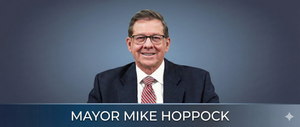
Newly selected Mayor Mike Hoppock opened his first statement by emphasizing gratitude, continuity, and the people behind city government.
“It is an honor to serve as the mayor of Salina,” Hoppock said. “I feel blessed to live in this community. My wife and I have been here over 45 years, and there’s not another place I would rather live.”
He thanked his wife and the spouses of other commissioners, noting that “it takes time away from your family to serve as a commissioner, and it can be somewhat stressful, not only for the commissioner, but also for their family.” Hoppock also credited city staff for much of Salina’s success. “Sometimes we probably get too much credit for what goes on,” he said. “We have a lot of people behind the scenes that give us a lot of information and guide us the direction we need to go to get things done in this community.”
Infrastructure, Planning, and Public Services in 2026
Looking ahead to 2026, Hoppock outlined several major projects, including the Jerry Ivy Splash Pad, which he said will be “up and going for the summer of 2026.” Design work will begin on East Magnolia Road and bridge improvements, an area he described as “a high traffic area and something that we need to work on to make it more safe for our citizens.”
Median upgrades are planned for Broadway Boulevard and South Ninth Street, and Fire Station No. 4 at Crawford and Markley is nearing completion. “We’re very fortunate that our financial situation allows us to either pay for part of that or all of it in cash,” Hoppock said. “That will allow us to save thousands of dollars as a community in interest.”
Renovation work continues at the Salina Police Department, and the city has approved a homelessness strategic planning process. “I’m guessing that there’s some people in the public that will be asked to be a part of that,” Hoppock said. The city will also begin updating its comprehensive plan, last completed more than a decade ago. “It’s a road map of how our community is going to move forward,” he said. “We will look at where we are today and decide how we want to move forward in the future.”
Housing, Jobs, and Downtown Investment
Hoppock pointed to steady progress in housing, highlighting Magnolia Commons near Menards, Aero Plains townhomes, and multiple subdivisions expanding across Salina. Of Magnolia Commons, he said developers were “very pleased with the way it was moving forward,” citing strong demand and waiting lists.
Economic development remains strong, he said, noting Kubota’s continued expansion after filling a 700,000-square-foot facility and plans for a new testing center. Kubota is projecting “under 300 jobs by the year 2030.” He also highlighted K-AIRS’ new facility at K-State Salina, Amazon’s distribution center south of the airport, and a new SkyWest maintenance lease. “This is extremely important,” Hoppock said of the SkyWest agreement. “It helps solidify our nonstop flights to Denver, Chicago, and Houston, while bringing in new jobs.”
Downtown Salina continues to see investment through Tax Increment Financing. “Those dollars must be spent in the TIF district, which is located downtown Salina,” Hoppock said. He also detailed early STAR bond payments totaling $7.21 million. “With this being done, this will save hundreds of thousands of dollars in interest payments and will allow the STAR bonds to be paid off early,” he said, adding that a new downtown hotel and parking facility could be discussed in 2026.
Taxes, Financial Stability, and the Road Ahead
Hoppock addressed property taxes directly, noting Saline County ranks 90th out of 105 Kansas counties in total mill levy. “I think that speaks well not only for this commission, but for the county commission, the school board, and the airport authority,” he said.
Among comparable Kansas cities, Salina has the second-lowest city mill levy, dropping from 30.348 in 2023 to 28.568 in 2026. “We have not asked for an increase in our revenue or in the amount of property tax being collected since 2024,” Hoppock said, emphasizing the city’s revenue-neutral approach. He also noted that a change in banking services has increased annual interest earnings from roughly $300,000 to more than $4 million.
In closing, Hoppock pointed to park upgrades, equipment replacement planning, vehicle leasing, and the success of the transient guest tax, which is funding turf replacement at local sports facilities. “Salina continues to be a model of public-private partnerships,” he said, adding that other communities often ask how Salina accomplishes what it does.
He credited residents, city staff, and the commission for that success and closed by calling for “an exciting and productive 2026” before adjourning the meeting.