
Following the Salina City Commission’s 5–0 vote to authorize a contract with SHG Advisors to develop a citywide homelessness strategic plan, City officials provided additional clarification to Salina311 on how homelessness data is currently collected, managed, and shared.
The Commission’s vote approved a 12-month planning effort beginning in January 2026, after an RFP process that drew 12 applicants nationwide with proposals ranging from approximately $53,000 to more than $1 million. City staff said the selected firm, SHG Advisors of Colorado, stood out for its experience in both rural and urban communities and its emphasis on actionable recommendations rather than purely theoretical analysis.
Why data is central to the plan
Community Relations Supervisor Michelle Martin told Commissioners that while Salina has been involved in homelessness response since at least 1994, largely through federal Emergency Solutions Grant (ESG) funding, the City lacks a unified, City-adopted framework that aligns agencies, data, and priorities.
Following the vote, Salina311 asked for clarification on how homelessness data is currently collected and what information is available to the public.
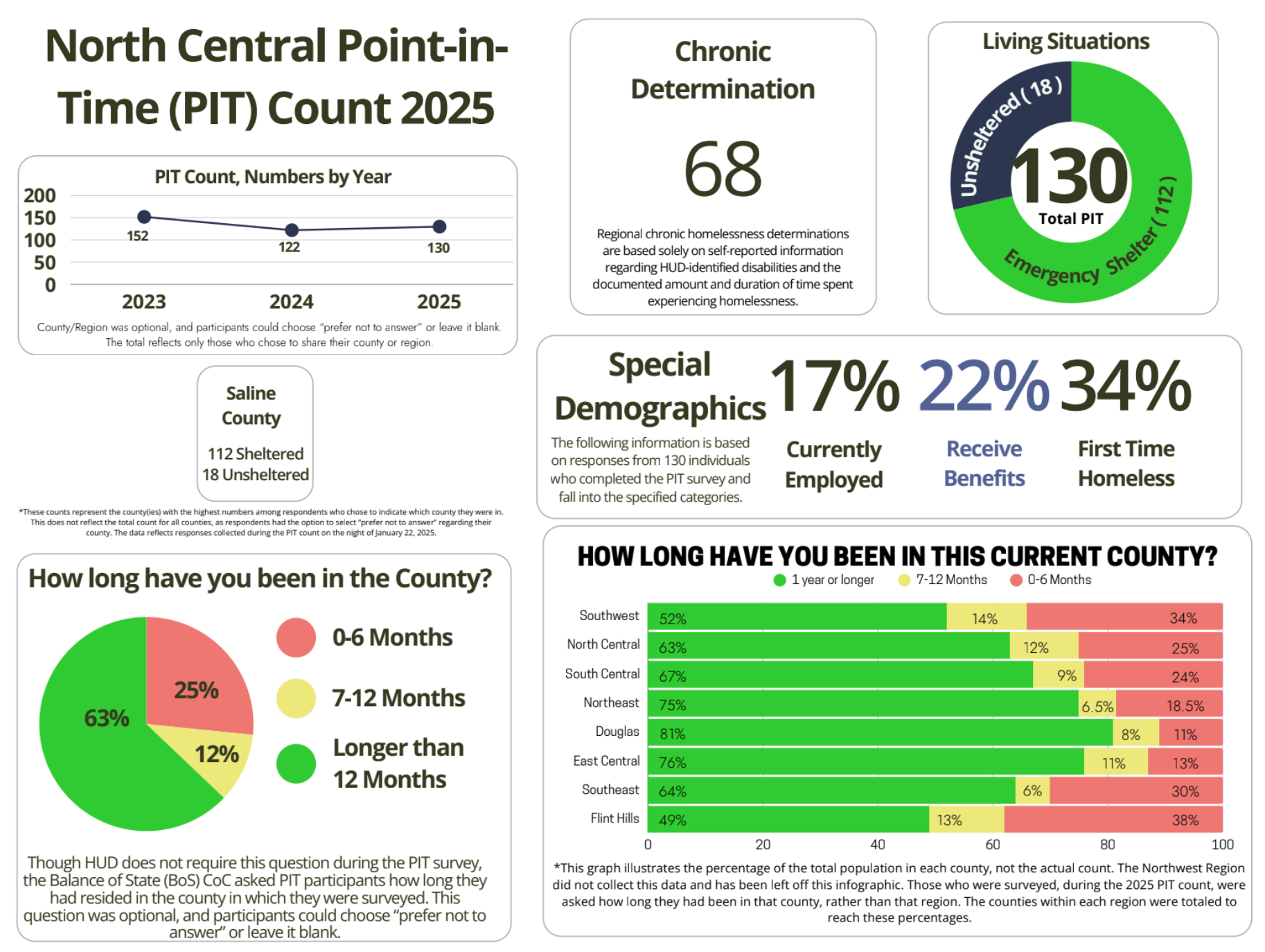
According to Martin, homelessness data beyond the annual Point-in-Time (PIT) count is collected and maintained by the Kansas Statewide Homeless Coalition, which serves as the lead agency for the Balance of State Continuum of Care (BoS CoC) under HUD.
“Beyond the annual Point-in-Time (PIT) count, homelessness data for this region is collected and maintained through the Kansas Statewide Homeless Coalition,” Martin said.
Local providers submit data to the Coalition, which reviews, deduplicates, and validates the information before submitting it to HUD. Official PIT results are not released publicly until HUD completes its review, typically later in the year.
The Coalition publishes annual reports and regional summaries, which are publicly available and contain aggregated data rather than individual records.
GIS mapping used internally
During the Commission meeting, City staff referenced a GIS-based mapping system used to log locations where unhoused individuals are encountered. Martin clarified that the map is not a formal dataset and is not intended for public reporting.
“The GIS-based mapping referenced during the meeting is not a formal reporting or statistical tool,” Martin said. “Instead, it functions as an internal coordination tool.”
The system allows City departments and outreach partners to place general location markers without identifying individuals. The purpose is to improve coordination, reduce duplication of outreach efforts, and assist with planning for the annual PIT count.
Built for Zero and performance benchmarks
Salina’s participation in the Built for Zero initiative is also coordinated through the Kansas Statewide Homeless Coalition. Built for Zero focuses on measurable outcomes such as how quickly individuals move from unhoused to housed and whether housing placements remain stable for at least 12 months.
Martin said benchmarks and reporting standards are established by Built for Zero and HUD, but decisions on public dashboards or routine reporting timelines are made at the state level.
“At this time, no definitive timeline has been established for when such tools may be available to the public,” she said.
Access to underlying data
Martin also addressed questions about access to raw data files, such as CSV datasets. She said much of the information used in homelessness analysis contains confidential and personally identifiable data protected under federal and state law.
“The City does not directly enter or manage HMIS data,” Martin said, noting that the Homeless Management Information System (HMIS) is administered by the Kansas Statewide Homeless Coalition. Public access is generally limited to aggregated reports and summaries, with data governance handled at the state level.
How this ties into the new plan
City officials have said the strategic plan approved by the Commission is intended to address many of these challenges by:
- Inventorying existing programs and resources
- Identifying gaps, barriers, and bottlenecks
- Establishing shared performance measures
- Creating a unified framework that agencies and funders can rely on
The approved contract covers planning and analysis only. Any future steps — including staffing, facilities, or funding allocations — would require separate Commission action.
If finalized as planned, the homelessness strategic planning process will run throughout 2026, with the completed plan brought back to the City Commission for review and potential adoption.
City leaders have said the goal is to move from discussion to direction, creating a coordinated, data-informed approach that aligns City efforts with state and federal systems while providing clearer accountability moving forward.