
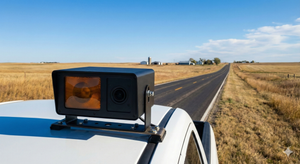
Following public comment at a recent Salina City Commission meeting raising concerns about license plate reader cameras, Salina311 submitted a detailed list of follow-up questions to the Salina Police Department regarding the scope, policies, access, and oversight of Automated License Plate Reader (ALPR) systems currently operating in Salina.
SPD provided written responses and directed Salina311 to its governing policy, General Order P3223, last reviewed in June 2025.
Number of cameras currently in use
According to SPD, the department currently operates:
- 22 fixed Flock cameras
- 1 mobile Flock Flex camera
- 12 fixed ELSAG (Leonardo) cameras
- 9 mobile ELSAG cameras
SPD stated it does not release information on the locations of the cameras, citing operational security considerations.
When officers may access ALPR data
SPD confirmed that access to ALPR data is governed by Policy P3223, which states that:
“ALPR data will only be accessed by Authorized Users for a legitimate law enforcement purpose.”612420
All searches must include a stated law enforcement reason, and when available, a case number must be entered into the system. If no case number exists, users are required to document the type of crime and location.
Warrant requirements
SPD confirmed that officers may access and search ALPR data without a warrant, provided the search complies with departmental policy and is conducted for a legitimate law enforcement purpose.
The policy further specifies that ALPR alerts alone cannot be used to stop or detain an individual unless additional reasonable suspicion exists or supervisory authorization is provided, depending on the alert type.
Who can access the data
Access to ALPR systems is limited to Authorized Users, defined in policy as criminal justice practitioners with proper clearance, including:
- Commissioned officers
- Crime analysts
- Emergency communications personnel
SPD also confirmed that Salina shares ALPR data with multiple law enforcement agencies nationwide. Requests from outside agencies must be reviewed by an SPD supervisor and evaluated based on the circumstances of each request.
Data retention periods
Retention time varies by system:
- Flock camera data: retained for 30 days
- ELSAG (Leonardo) camera data: retained for up to two years
Flock data is automatically deleted after 30 days unless preserved for evidentiary purposes. Policy requires officers to save any ALPR data used in a case into the department’s evidence system under the appropriate case number.
Auditing and oversight
SPD stated that:
- All ALPR searches are logged
- Monthly audits are conducted
- Oversight is handled by an appointed ALPR Administrator, who is responsible for:
- Managing user access
- Conducting audits
- Approving hotlists
- Ensuring training compliance
SPD’s ALPR policy is reviewed annually and was most recently reviewed in June 2025.
Use in investigations
SPD confirmed that ALPR technology has:
- Resulted in multiple arrests
- Assisted in arrests
- Helped recover stolen property
Per policy, when ALPR data contributes to a case outcome, officers are required to log that usage for statistical and accountability purposes.
Policy limitations
General Order P3223 explicitly prohibits:
- Commercial use of ALPR data
- Public disclosure without authorization
- Use for non-law-enforcement purposes
The policy also states that users must consider privacy, civil rights, and civil liberties when accessing or using ALPR data.
Sidebar: Flock vs. ELSAG Cameras in Salina
Salina currently uses two Automated License Plate Reader (ALPR) systems: Flock Safety and ELSAG (Leonardo). While both capture license plate images, they differ in deployment and data retention.
Flock Safety Cameras
- 22 fixed cameras
- 1 mobile “Flock Flex” camera
- Data retained for 30 days
- Commonly used for real-time alerts, stolen vehicles, and BOLOs
- Data automatically deletes unless preserved for a case
ELSAG (Leonardo) Cameras
- 12 fixed cameras
- 9 mobile cameras
- Data retained for up to 2 years
- Often used for longer-term investigative analysis and pattern review
What both systems have in common
- Capture license plate images only (not facial recognition)
- Searches must be for a legitimate law enforcement purpose
- Access limited to authorized SPD personnel
- Searches are logged and audited monthly
- Data can be shared with other law enforcement agencies under policy
What SPD does not disclose
- Exact camera locations
- Specific investigative use details tied to active cases
Governing policy
- Use, access, retention, auditing, and data sharing are governed by SPD General Order P3223, last reviewed June 2025.