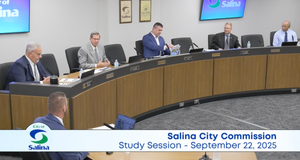
SALINA, Kan. — A proposed SpringHill Suites hotel and five-story parking garage in downtown Salina has ignited a detailed discussion among city commissioners, developers, and administrators, centering on whether the project can be sustained by the local market and how the multimillion-dollar garage would be financed.
The site in question is a city-owned parking lot on 7th Street, which currently generates no property tax revenue. Under the plan, the land would be transferred to developers for the hotel, while the city would assume long-term responsibility for the garage.
“It’s a little unique in that it would take place on a city-owned public lot,” City Manager Jacob Wood told commissioners. “At some point, we would have to figure out transfer of ownership. The goal is to fund the parking garage with taxes generated within the district, rather than new taxes citywide.”
The garage, estimated at $13 million to $14 million, would be financed with bonds, backed by several overlapping revenue streams:
- A portion of Tax Increment Financing (TIF) from the Downtown TIF district, though the 7th Street lot would first need to be added back into the district.
- A new TIF district limited to the hotel site, extending property, sales, and transient guest tax collections for up to 20 years.
- Sales tax and transient guest tax (TGT), currently pledged to STAR bond projects, which could be redirected once those obligations expire.
- A Community Improvement District (CID), adding a 1 to 2 percent sales tax at the hotel, aligning with rates at other hotels downtown.
- Potential amendments to STAR bond projects, allowing part of the revenue to be shifted to the garage.
Wood acknowledged the complexity. “There’s a lot of process here — amending the downtown master development agreement, creating new districts, negotiating incentives. But we believe this structure would make the garage financially viable.”
Demand Questions
The question of whether Salina can support another hotel drew pointed inquiries. Commissioner Trent Davis asked whether market studies had been conducted.
Guy Walker, representing Lighthouse Properties, said the group relied on Smith Travel Research (STR) data, which allows hotels to measure their performance against a defined set of competitors. For Homewood Suites, Walker said, the comparison set includes Hilton Garden Inn, Courtyard, Fairfield, Holiday Inn, and Holiday Inn Express.
“If you just look at that competitive set, the answer would probably be no,” Walker said. “There probably isn’t necessarily room for another hotel. But if you look at what Homewood is doing by itself, the answer would be yes.”
Homewood, Walker noted, has maintained occupancy above 75 percent year-round, a threshold developers use to gauge demand.
Walker argued that brand positioning also matters. “Marriott is significantly larger than Hilton in terms of reward and reservation systems,” he said. “Salina only has two Marriott hotels, totaling fewer than 150 rooms. We believe that strongly supports the idea of an additional 80 rooms under the Marriott flag.”
While no independent market study has been commissioned, Walker said STR data and brand reach make the case. He also pointed out that once financing districts such as TIF and STAR bonds expire, their tax collections would eventually flow back to the city, county, schools, and state.
Garage Operations and Maintenance
Commissioners pressed for details on the garage itself. Commissioner Mike Hoppock asked how many floors it would contain — the answer: five.
He also asked whether parking would remain free. “I don’t think we want to take on the task of managing paid parking,” a city staff member responded. “The bang for your buck is not enough to make it worthwhile. We would anticipate it not being paid parking.”
Hoppock further asked about long-term maintenance costs, referencing the parking garage at Salina Regional Health Center. Staff said they were gathering data from the hospital and other communities.
“There obviously will be some maintenance — annual elevator inspections and other ongoing needs,” staff noted. “We’ll have to make sure it’s kept up and running.”
Broader Implications
For Wood, the project represents an opportunity to turn an underused parcel into a tax-generating asset.
“Right now, this lot generates zero,” he said. “The revenue from hotel sales tax, TGT, and property tax would be a lot bigger than zero, and it would help offset the cost of both the hotel and garage long term.”
After the discussion, the Salina City Commission authorized City Manager Jacob Wood to continue moving forward with the proposal, allowing staff to begin the detailed work of drafting financing mechanisms, exploring district adjustments, and negotiating with developers as the project advances.
Developers noted that the franchise agreement for the proposed SpringHill Suites already sets a timeline in motion. A franchise fee and application fee have been paid, triggering a two-year window to begin construction. While that deadline only requires work to start, developers said they will aim to time construction during optimal building seasons to minimize disruption to the downtown parking lot.
They cautioned, however, that significant groundwork remains. Amendments to TIF districts, changes to the master development agreement, and required public hearings will all take time. Project timelines will be refined once the City Commission confirms its interest in moving forward.