
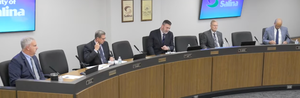
The Salina City Commission held a detailed discussion on proposed safety and traffic-control changes at 9th Street and Water Well Road, reviewing a consultant’s recommendation for a single-lane roundabout and public feedback from trucking and mobility stakeholders. No final decision was made. Commissioners indicated they want to see performance under an interim all-way stop and continue stakeholder engagement before selecting a permanent solution.
How We Got Here
- In July 2025, commissioners approved a design contract with Kaw Valley Engineering to evaluate alternatives at 9th & Water Well.
- The intersection is currently two-way stop controlled (Water Well stops, 9th flows), with estimated daily volumes of ~4,700 vehicles on 9th and ~3,200 on Water Well, and 10 reported crashes since 2022, including two injury crashes, according to staff.
- The consultant’s analysis compared a signalized intersection and a modern roundabout, modeling current conditions and 20-year growth with nearby industrial and commercial build-out.
Staff & Consultant Recommendation
- Recommended option: a single-lane roundabout sized for heavy trucks, with design based on WB-67 wheelbase templates and turning simulations.
- Why single-lane: projected volumes remain within single-lane roundabout capacity; two-lane roundabouts introduce more complex operations and lane discipline issues for trucks.
- Bypass movement: to address heavy right-turns from southbound 9th to westbound Water Well (toward I-135), engineers propose a right-turn bypass lane to keep that movement out of the circulating flow.
- Safety basis: Roundabouts reduce severe crashes by lowering speeds and eliminating right-angle conflicts. Staff cited national research indicating large reductions in fatal and serious-injury crashes when stop- or signal-controlled intersections are converted to roundabouts.
- Operating threshold: Engineers noted single-lane roundabouts typically operate efficiently up to roughly 12,000 vehicles per day per approach before multi-lane designs are considered. Under planning horizons, the intersection is expected to remain within effective single-lane capacity.
Interim Change: All-Way Stop
Public Works said the intersection will be converted from two-way stop to all-way stop as a near-term safety countermeasure. Message boards will be used in advance and after the change; timing is dependent on equipment availability, with a goal of implementation before Thanksgiving. Staff acknowledged an all-way stop carries more delay than a signal but improves control compared to the current two-way stop.
Trucking Industry Concerns
Representatives of local carriers and freight-dependent businesses raised multiple issues:
- Gap acceptance & queuing: Concerns that slower truck acceleration could make it difficult to enter during peak car flows, creating backups, especially at after-work peaks and when trucks stage at nearby facilities.
- Crash profile: While acknowledging that roundabouts reduce severe T-bone crashes for general traffic, speakers flagged truck rollover risk as a key safety concern for drivers, citing industry studies and isolated examples.
- Construction duration & cost: Requests for clarity on build time (and associated detours) and skepticism about comparative 50-year life-cycle cost assumptions vs. a traffic signal.
- Engagement: Some operators said they were not contacted for late-stage input and asked to review detailed geometry before the design is finalized.
Engineering Responses
- Volumes & trucks: The study assumed ~10% trucks. Engineers referenced examples where even higher truck shares have been successfully served with modern designs.
- Design speed: Posted approaches are 40–45 mph today; roundabout entries would be signed ~30 mph, with 20–25 mph design speed for passenger cars within the circle and ~10–15 mph for trucks.
- Peak-hour balance: If a movement dominates at certain times, features like bypass lanes and approach metering can be considered. The recommended geometry will be tested and adjusted with truck turn simulations.
- Stakeholder input: Staff said they have met with several operators (and will continue to) and are open to reviewing turning paths, trailer configurations, and operational needs specific to local fleets.
Commission Discussion
- Data vs lived conditions: Commissioners weighed national safety data against local peak-period patterns, asking for more clarity on truck counts per hour, staging impacts near driveways, and queue spillback risk toward the interstate.
- Observation period: Several commissioners want to observe the interim four-way stop and expand outreach before a final choice.
- Public safety lens: Commissioners emphasized the goal of reducing severe injuries and fatalities for the full user group, noting trucks are roughly 10% of total traffic but crucial to the local economy.
- Next steps: No vote selecting a permanent control type was taken. Staff will implement the all-way stop, continue meetings with end users (including sanitation and private carriers), and bring back refined design details and operational analysis.
What’s Next
- Interim control: Conversion to all-way stop with advance notice and monitoring.
- Additional engagement: Targeted sessions with trucking companies, nearby shippers, and property owners to review geometry, turning simulations, peak-hour flow, and driveway interactions.
- Return to Commission: Staff and the consultant will return with updated findings, cost detail, construction phasing considerations, and recommended mitigation (such as the right-turn bypass lane) before a final decision is requested.
During Monday’s discussion, commissioners agreed to postpone final consideration of the Ninth & Water Well intersection improvement plan to allow additional time for traffic data review, design clarification, and stakeholder input. The matter will now return to the City Commission on Monday, December 8, 2025, at 4:00 PM.