
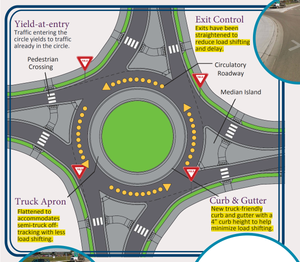
The Salina City Commission voted 4–1 on Monday to advance the design of a single-lane roundabout at the Ninth Street and Water Well Road intersection, directing staff and Kaw Valley Engineering to begin formal design work. The decision followed more than an hour of staff explanation, engineering clarification, and public testimony from residents, truck drivers, landowners, and local business representatives.
Staff Reaffirms Recommendation for Roundabout
City staff reiterated their long-standing recommendation for a roundabout, citing safety performance, long-term traffic flow, and national design standards. Key points included:
- Peak-hour truck traffic: 25 trucks out of 798 vehicles (3–5 p.m.), based on updated counts requested by the Commission.
- Comparison to Junction City: The Chestnut Roundabout there sees 32 peak-hour trucks and reported one serious injury accident in five years, according to KDOT’s Drive to Zero dashboard.
- Truck maneuverability: Engineering guidance from the Oregon DOT shows a typical 76-foot semi requires a 9-second gap to safely enter a single-lane roundabout from a stop.
- Project cost clarification:
- $900,000 (signal-only) vs. $1.9 million (roundabout-only) are strict intersection-control comparisons.
- The total project budget is $4.6 million, including improvements to all four legs of the intersection and 1,700 feet north along Ninth Street to MacArthur, with curb and gutter, roadway replacement, and drainage improvements required under either option.
Staff emphasized that either design option requires full concrete replacement and significant roadway upgrades.
Four-Way Stop Will Be Installed December 17
Commissioners questioned the timeline for implementing the temporary four-way stop previously discussed. Staff confirmed:
- Traffic control message boards are already in place.
- New stop signs arrive by December 17, when the intersection will convert to a four-way stop.
- Warning signage will remain in place for several weeks.
- Staff noted that behavior change at long-standing intersections typically takes up to two years for full driver acclimation.
Public Testimony: Trucking Industry Strongly Opposed to Roundabout
Multiple speakers from the trucking industry urged the Commission to choose a traffic signal, not a roundabout. Key themes:
Jamie Bradley, Doug Bradley Trucking
Bradley presented a detailed comparison chart covering cost, construction timelines, flexibility, emergency access, and operational considerations. Points included:
- Cost comparison: Bradley cited a $650,000 estimate for signals vs. the $4.6 million total roundabout project, though commissioners clarified the true cost difference is closer to $1 million, not $4 million.
- Operational impact: Signals can be reconfigured, removed, or reused; roundabouts cannot.
- Construction disruption:
- Signals: approx. 2 months, minimal closure.
- Roundabout: approx. 8 months, unknown closure impacts.
- Emergency services: Can manipulate signals but not a roundabout.
- Public preference: Bradley referenced a Salina311 poll with over 7,000 responses, showing 69% of respondents opposed roundabouts.
Bradley emphasized that trucks can physically navigate a properly designed roundabout but argued it presents greater rollover risk and unacceptable operational hazards.
Additional speakers echoed concerns:
- Seal Sanderson shared concerns about trailer tracking and tight turning movements.
- Ben Winholtz urged the Commission to “listen to the people,” noting truck operators and nearby businesses overwhelmingly oppose the roundabout.
- Doug Remp suggested rumble strips as an attention-getter for drivers adapting to new traffic control.
- Business owner Mark Augustine, who owns property at the intersection, supported improvements but noted drainage and access must be addressed regardless of design.
Commission Deliberation
Commissioners acknowledged both sides but leaned heavily on engineering data, long-term planning, and national safety findings.
Key points raised:
- Federal Highway Administration data shows an 82% reduction in injury crashes when replacing a two-way stop with a roundabout.
- Roundabouts significantly reduce high-severity T-bone crashes common at rural high-speed intersections.
- Commissioners stressed that neither they nor the public are roadway design experts; therefore, they rely on engineering recommendations unless clear evidence contradicts them.
- Several commissioners personally observed the Junction City roundabout and reported no navigational problems for trucks.
Commissioners also noted:
- Both alternatives will require major roadway construction and cause temporary disruption.
- The decision must consider 20-year planning, not short-term preference or convenience.
- The four-way stop trial will still proceed, but it is not expected to materially change the engineering recommendation.
Commissioner Bill Longbine acknowledged heavy public opposition but pointed to data-driven safety metrics and long-term traffic efficiency.
Final Vote
The Commission voted 4–1 to move forward with the roundabout design.
One commissioner dissented, citing public opposition, trucker feedback, and concerns about long-term drivability.
Next Steps
- Kaw Valley Engineering will begin the detailed roundabout design.
- The temporary four-way stop will activate on December 17.
- Future design stages may incorporate truck-industry feedback, entry radii adjustments, and improved access to nearby businesses including Advance Auto and Exide.