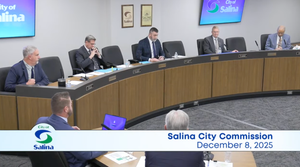
The Salina City Commission on Monday approved seven of eight ordinances tied to a comprehensive overhaul of the city’s building and trade codes. The updates move Salina toward the 2018 International Code Council (ICC) standards and related national model codes. One ordinance, tied to the International Fire Code (IFC) and particularly its new retroactive sprinkler requirement for certain assembly spaces, was postponed to December 22 for further review.
The updates represent one of the most significant code modernization efforts the city has undertaken in more than a decade.
Overview of the Code Update
Director of Community & Development Services Lauren Driscoll presented the ordinance package, noting that:
- Salina is currently operating under significantly older codes.
- National model codes are updated every three years by ICC and IAPMO.
- Local subcommittees met 38 times over two years to evaluate proposed changes.
- The Building Advisory Board (BAB) reviewed subcommittee work on November 5 and December 2 and forwarded recommendations to the Commission.
Driscoll emphasized that updated codes increase life safety, structural integrity, and consistency, while reducing the number of local amendments from 189 to 141.
The new local codes would officially take effect January 1, 2026, but with a transition window allowing active or pending permits to proceed under the current code, ensuring projects already in motion are not disrupted.
Key Code Areas Updated
Uniform Mechanical & Plumbing Codes, National Electric Code, International Building Code
Mostly clarity updates, modernization of standards, and alignment with national norms.
International Residential Code (IRC)
- Updates for smoke alarm requirements during remodels
- New roof access standards for solar panel installations
- Adoption of Appendix Q (tiny homes), formalizing standards for ladders, mezzanines, and compact living layouts
Uniform Swimming Pool, Spa & Hot Tub Code
Now a standalone code instead of being embedded in other sections.
Local amendment: power safety pool covers are not allowed as substitutes for permanent physical barriers due to enforcement and reliability issues.
International Existing Building Code (IEBC)
Provides a nationally recognized framework for renovating older structures.
Major Discussion Point: International Fire Code (IFC) Sprinkler Requirement
The most contentious update involved IFC Section 1103.5.1, a retroactive requirement affecting Group A-2 occupancies (venues serving alcohol) with an occupant load of 300 or more.
This retroactive requirement—rare in national codes—arises from long-standing national fire safety concerns involving assembly spaces with alcohol consumption.
Establishments Identified as Impacted
- Muse Ballroom – Occupancy exceeds 300, but no alcohol service; not affected.
- VFW Post – Occupancy above 300; several annual events include both alcohol and large crowds.
- Masonic Temple – Occupancy above 300; 4–5 large events per year include alcohol.
Staff recommended a local amendment allowing:
- Alcohol at events below 300 people,
- Events above 300 people only if no alcohol is present,
- Plus temporary exceptions for already-booked 2026 events with deposits submitted before Jan. 1.
Concerns Raised
- VFW representatives stated they did not fully understand the implications before tonight’s meeting.
- The Masonic Temple supported temporary allowances to honor upcoming booked events.
- Commissioners expressed concern about implementing a costly retrofit with only weeks of notice.
Commission's Decision
The Commission unanimously chose to postpone the fire code ordinance (25-11266) until December 22, directing staff to revise it so that:
- The sprinkler requirement and related local amendment will not take effect until January 1, 2027, giving affected establishments a full year to plan.
- The remainder of the code package may still move forward.
Appendix D – Emergency Access Revisions
Changes approved under other ordinances include significant updates to Appendix D governing emergency vehicle access:
- Remote access spacing standardized at 300 feet, simplifying prior formulas tied to parcel geometry.
- Clear rules for when single-access developments are allowed, including boulevard-style road designs with 29-foot travel lanes and strict unit limits.
- Roads serving fire access must support 75,000 pounds and be certified by a Kansas engineer.
- Long-term maintenance responsibility for non-public emergency access roads is now explicitly placed on private property owners.
Fire Marshal Joe Caprisi also addressed public concerns linking access standards with traffic-calming devices, explaining that roundabouts, speed humps, and narrowed roads can increase emergency response times and damage apparatus.
Final Actions
The Commission approved seven ordinances:
- 25-11264
- 25-11265
- 25-11267
- 25-11268
- 25-11269
- 25-11270
- 25-11271
All passed with the added clarification:
“Pending or active permits will be allowed to proceed under the current code.”
Ordinance 25-11266 (International Fire Code) was postponed to December 22 for revision.
All votes were unanimous.